
Sustainable Power
Solar Energy for Remote Communties
Transforming Underserved Communities with Solar Lighting Systems
Picture a world where nightfall doesn’t plunge entire neighborhoods into darkness. Thanks to solar lighting systems, this reality is within reach for countless remote communities. These innovative solutions harness the power of the sun to provide safe, reliable light, fundamentally improving residents’ lives.
How Solar Light Systems Improve Quality of Life in Remote Communities
Remote communities often face significant challenges, including a lack of electricity, clean water, and healthcare services, not to mention limited educational and economic opportunities. Solar lighting systems are pivotal in the following ways:
Click to Watch the Video Below

Facilitating Education and Skills Development
Education is a fundamental human right. Unfortunately, students in remote communities lacking grid connection or infrastructure are plunged into complete darkness in the evenings, which shuts down any chance of studying after sunset. Forcing kids to rely solely on daylight hours for homework and academic pursuits creates a major barrier to education.
The limited window for learning hinders their ability to compete with students in more developed areas and restricts their academic opportunities. According to GOGLA’s Powering Opportunity report, solar lamps extend study hours for children, facilitating better academic performance and educational attainment. It also creates suitable occasions for lifelong learning and skills development, empowering individuals to pursue higher aspirations and break the cycle of poverty.

Improving Access to Healthcare
In remote areas lacking grid access, healthcare centers face a serious challenge: preserving vital medicines and vaccines. Without dependable refrigeration, these life-saving resources can spoil, rendering them ineffective and jeopardizing the entire community’s health. A lack of proper storage contributes to the spread of preventable diseases like measles, diphtheria, and tuberculosis (TB).
It hinders efforts to improve maternal and child health outcomes. Solar energy helps power basic appliances and equipment, for instance, refrigeration units, portable rechargeable batteries, ventilation systems, and more. Solar lighting contributes to disease prevention as well as improved maternal and child health outcomes by strengthening healthcare infrastructure.

Combating Food Insecurity
Unreliable water supplies create a precarious situation for farmers in outlying rural communities. During periods of limited rainfall, crops fail leading to food scarcity and hunger (famine).
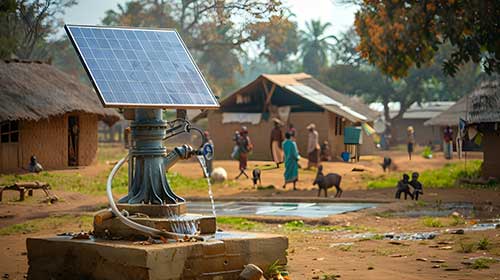
Access to solar-powered water pumps enables communities to irrigate crops consistently, allowing farmers to cultivate crops throughout the year, even during dry seasons. This minimizes reliance on unpredictable rainfall and enhances agricultural productivity for greater food security and stability for families in remote areas.

Building Thriving Businesses and Higher Incomes
Extended hours of productivity afforded by solar lighting translate into increased incomes and thriving businesses. Shops stay open longer, thus attracting buyers and boosting local economies.
Solar projects also catalyze job creation and subsequent entrepreneurial activities, particularly among marginalized groups. Women, specifically, benefit from solar ovens launching profitable ventures such as baking businesses that enrich their lives and empower their communities. Entrepreneurial endeavors flourish, driven by access to light and expanded economic opportunities for local communities.

Enhancing Safety
Residents in rural areas are forced to walk long distances, sometimes navigating treacherous paths to fetch clean water; this poses significant safety risks, especially for women after dark. Solar-powered lights mitigate these dangers by storing energy throughout the day to guarantee illumination even after sunset. Women venturing out at night can carry portable solar lanterns that provide a dependable light source on their journeys to and from home.
Cost Savings
Replacing inefficient and polluting sources like kerosene lanterns or candles with solar lighting yields substantial savings for rural and remote homes. Even though the upfront fee of installing a solar lighting system may seem high, it quickly pays for itself by eliminating ongoing fuel expenses. These savings can be redirected to other essential household needs or toward pursuing education and business ventures that promote economic resilience and independence.
The Benefits of Solar Lighting Systems in Remote Communities
Numerous reasons to choose solar lighting systems over traditional lighting methods exist, like incandescent bulbs, fluorescent lights, and kerosene lanterns. Solar power is a clean and renewable energy source. Solar lighting systems harness the sun’s energy to generate electricity, which greatly reduces reliance on fossil fuels like wood in remote communities and minimizes greenhouse gas emissions.
The use of solar power translates to cleaner air, a smaller carbon footprint, and a positive impact on the fight against climate change. Whereas an initial investment is required for the solar panels and system components, solar lighting systems offer long-term cost savings. Once installed, they require minimal maintenance and draw power from the free and abundant sunlight. This is particularly important for remote, underserved communities.
It frees them from dependence on unreliable, often non-existent electrical grids while eliminating the ongoing burden of expensive fuel costs associated with traditional lighting sources. Some regions also offer government incentives or rebates for adopting solar energy, further lowering the upfront cost. Solar lighting systems offer unparalleled versatility and adaptability.
They can be easily installed in both urban and rural locations without extensive infrastructure or wiring. Solar systems are especially beneficial in remote areas or during emergencies to provide reliable illumination where conventional power sources are unavailable.
Advancements in technology have led to the development of innovative features such as motion sensors, adjustable brightness settings, and remote monitoring capabilities for enhanced functionality and efficiency. Modern solar systems are also built to withstand harsh weather conditions and come equipped with long-lasting batteries for stable illumination throughout the night.
Solar Light System Overview
A solar lighting system is a self-contained unit that captures the sun’s energy and converts it into light. It operates on the principle of photovoltaic technology, absorbing sunlight during the day to illuminate spaces at night. Every unit comprises several components, including:
- Solar Panels: These are the backbone of a solar lighting system and consist of photovoltaic (PV) cells that absorb sunlight and convert it into electricity. The cells are typically made of silicon, which releases electrons when exposed to sunlight, generating an electric current. Solar panels are designed to capture and maximize sunlight energy production even in low-light conditions.
- The Battery: It serves as the energy storage unit within a solar lighting system, storing excess electricity generated during daylight hours for use at night. Generally, these batteries are rechargeable to allow for continuous lighting system operation regardless of solar availability. Advanced battery technologies, like lithium-ion, offer high energy density and longer lifespan for authentic performance over extended periods.
- Charge Controller: This device regulates the flow of electricity between the solar panel and the battery. Its primary function is to prevent overcharging, which can lead to decreased battery lifespan or damage. The charge controller also regulates the voltage and current to ensure optimal charging efficiency, effectively enhancing the overall reliability and longevity of the solar lighting system.
- LED Lights: Modern solar lighting systems use light-emitting diodes or LED lights instead of traditional incandescent or fluorescent bulbs. The specific job of LED lights within a solar lighting system is to convert stored electrical energy from the battery into visible light for various indoor and outdoor applications.
Solar LED lights are preferred for their energy efficiency. They consume significantly less power while producing bright, clear light. They also have a longer lifespan than conventional bulbs, which reduces the maintenance requirements and operating costs of the solar lighting system.
Types of Solar Lighting Systems
Different types of solar systems, for instance, hybrid, off-grid, and on-grid configurations, cater to varying needs and conditions in remote areas. Off-grid solar lighting systems operate independently of the central power grid. These systems rely solely on solar energy via solar panels to capture sunlight and charge batteries for nighttime illumination, thus providing a sustainable and self-sufficient lighting solution.
It makes off-grid solar lighting systems ideal for areas far removed from traditional infrastructure because they bypass the need for a central power grid. Remote and rural areas can depend exclusively on the abundant sunshine to capture energy and light their homes and streets at night. On-grid systems integrate with the existing grid infrastructure.
They use solar power as the primary energy source while accessing grid electricity as a backup during periods of low sunlight or high demand to ensure uninterrupted lighting service. Although on-grid solar lighting systems offer the benefit of backup grid power, they are not ideal for remote communities. By definition, remote or rural areas lack a stable grid connection/ infrastructure, thus rendering the on-grid system’s backup feature somewhat irrelevant.
Hybrid systems combine the features of both off-grid and on-grid systems. As such, they offer enhanced flexibility and adaptability to switch between solar and grid power based on energy availability and demand. This makes them versatile solutions for various environmental and operational conditions. For example, areas with occasional grid access or unpredictable weather patterns.
Join the Solar Solutions Collective Movement
At Solar Solutions Collective, we pioneer solar solutions that uplift marginalized families globally. We collaborate with non-profit organizations and community leaders to implement sustainable solutions that empower individuals toward economic development. If you share our vision of creating a sustainable and equitable world for underserved communities, we invite you to join us. Contact Us today to learn how you can get involved.